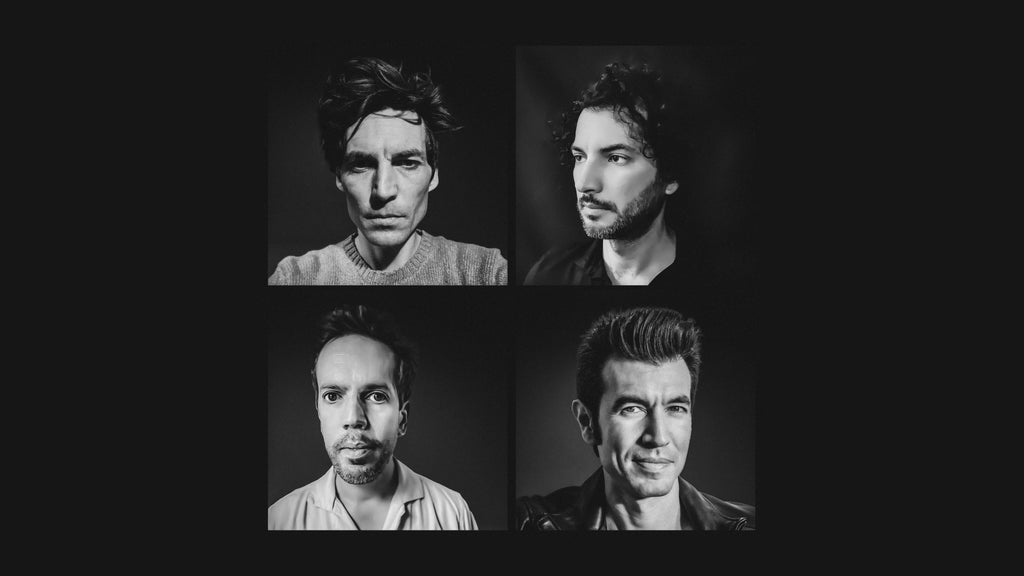
Since its release last May, Gomez's album "How We Operate" has consistently garnered critical and commercial acclaim with Entertainment Weekly, Billboard and NPR calling the album the band's finest. "How We Operate" was hailed as "The Best Rock Album of the Year" by The Wall Street Journal.
The title track off of "How We Operate" quickly became a staple track for the hit ABC series "Grey's Anatomy," where it was prominently featured in the season finale and show promos. In addition, the band celebrated their first #1 single on the AAA airplay charts with their current single "See the World," which remained in the top slot for 5 weeks.
This year alone, Gomez has been featured twice on The Tonight Show with Jay Leno performing both the title track as well as "See The World" and have also performed on Late Night with Conan O'Brien, The Late Late Show with Craig Ferguson, and Last Call with Carson Daly.
Solidifying their reputation for transcendent live performances, Gomez has sold out each leg of their 2006 and 2007 headlining tours, which included dates with the Dave Matthews Band as well as an opening slot at Madison Square Garden. Gomez are gearing up for a summer tour including a run of dates with The Fray starting in July.
Gomez, who have been touring and making records for over a decade, seems to have just arrived. "As a creative partnership, and as friends, we had to regroup and make a career-defining record," says Tom Gray (vocals, guitar, keyboards). Longtime cohort Ben Ottewell (vocals, guitar) concurs. "The last album (Split the Difference) was pretty rocking, and reflected the live show a lot. With this one, we wanted to focus on songs, melodies and words, rather than volume."
The band also features Ian Ball (vocals, guitar, harmonica), Paul Blackburn (bass, guitar), and Olly Peacock (drums). The quintet may have been playing together for a decade but their friendships date back even further. Ian and Olly have been friends since they were still in short pants, while the rest of the lads entered the picture as the duo progressed through academia. Drawing on their disparate tastes, which ranged from Nirvana to Woody Guthrie, Motown singles to barbershop quartets, Gomez honed a one-of-a-kind sound that incorporated all their influences around a shared point of reference: A deep, abiding love for creative music.
After releasing their debut single, "78 Stone Wobble" in spring of 1998, Gomez soon attracted international attention when they won the Mercury Music Prize for their debut full-length, Bring It On, which SPIN anointed "a damn beautiful album." It was followed by Liquid Skin (1999), and the rarities-and-B-sides compilation Abandoned Shopping Trolley Hotline (2000), and In Our Gun (2002).
2004 brought album number five, Split The Difference, hailed by the BBC as "one of the finest releases of the year." But soon after, Gomez literally split-- from their longtime label, Virgin Records. In 2005 Gomez inked a new deal with Dave Matthews' ATO Records, who issued the band's first live album, Out West.
The label switch has greatly benefited the band. "It's been a breath of fresh air, after the deeply ridiculous world of today's corporate record industry, where the tax year dictates creative output," says Gray.
To better focus their creative energies for their first studio release for ATO, Gomez enlisted their first outside producer, Gil Norton (Pixies, Foo Fighters). From their first meeting, the band felt confident they had made the right choice.
"The main thing with this record was to get everybody together in one room, working on all the songs together, and making sure there was a real unified vision," Gray confirms.
"On our old records, certain elements were carefully thought out, but a lot of things were simply done in the spur of the moment," explains Ottewell. "On this one, we didn't lose that spontaneity, but we thought things through a bit more. Ever since our second record, we've been involved in a long process of trying to tease out the best bits of what we do, and not clutter things up. Gil helped show us the way."
"The principle was to keep the whole recording very simple," says Ball of the manner in which the album's twelve tracks were written, rehearsed, and laid down. "If everyone didn't agree on a potential song, it was promptly withdrawn from consideration. Time and money were limited, which was good, because in the past we have occasionally tended to, shall we say, go to town."
At the same time, Norton recognized that he was overseeing a band with multiple songwriters that in essence, had grown up together. "Everyone had to be represented on this record," concurs Gray. "We needed to get the balance right again. Gil isn't at all conservative. He just loves a good song, done well, and he doesn't think that adding too much coloration actually helps bring a song to life."
"There's always been a certain ragged glory to Gomez," Grey concluded.
How We Operate retains and revitalizes that glory and presents it in a more immediately gripping form. "This is certainly the most cohesive record we've made," observes Ball. "And yet it remains stylistically genre-less-- which is to say, it's still brilliantly, unabashedly, Gomez."
Anatomy texts might not show it, but the greatest soul and blues music leaves no doubt that the hip bone is directly connected to the heart -- a fact that’s driven home in every note laid down by Black Joe Lewis and the Honeybears. As they prove on their Lost Highway debut, Tell ‘Em What Your Name Is, the Austin-based combo has the kind of gritty attitude and deliciously greasy groove-consciousness that’d pass muster in the toughest juke joint.
To paraphrase Ike and Tina Turner, Tell ‘Em What Your Name Is gives Lewis the chance to play nice and easy as well as nice and rough. He and his bandmates take the latter route more often -- as on the fiery, brass-laced opener “Gunpowder” and the unabashedly horndog anthem “Big Booty Woman.” But there’s far more than one trick up their collective sleeve, as borne out by the dark New Orleans march “Master Sold My Baby.”
“It’s weird…people say I come up with all these different kinds of songs, and I guess that’s true, but they all just come out naturally,” says Lewis, who cites James Brown and Lightnin’ Hopkins as two of his bigger influences. “If I sit down and try to write a song, it just sounds contrived. All the songs on this record, I just made up as I went along. I couldn’t do a lot of ‘em again if I didn’t have ‘em on tape.”
That from-the-gut stream-of-consciousness permeates the disc, with Lewis wailing wildly -- in a voice that’s one part Joe Tex, one part Tyrone Davis -- through sweat-soaked offerings like the gutbucket “I’m Broke” and “Please, Part Two” as his bandmates turn up the heat, taking a low simmer to a full boil with turn-on-a-dime precision.
“The thing about the band is that we play with each other, not against each other,” says Honeybears’ guitarist Zach Ernst. “It’s not a pissing contest, the way it is in some bands. We communicate with each other without speaking, and I think that has a lot to do with Joe’s attitude -- he has an amazing ability to just draw people in. For a lot of people, the blues is a museum piece, but Joe brings it into the moment.”
If not for a twist of fate, Lewis might never have gotten up on stage at all. Growing up in the small town of Round Rock, Texas, he was more likely to be found on the football field than in the band room -- but landing a job in an Austin pawn shop put him at a (shall we say) crossroads in life.
“My dad and my uncles listened to soul and blues when I was a kid, but I never really took much notice,” says Lewis. “When I was about 19 or 20, I was working in this pawn shop and all these guys would bring in guitars. One day, I started playing around with one and took it home and started teaching myself how to play.”
Buoyed by the encouragement of friends, Lewis soon gravitated to the fertile open mic scene of his adopted hometown, where he performed as a solo artist, a period he now laughingly recalls as “horrible…I was usually too drunk or too scared to put on a good show, but people kept asking me to come back.”
While he eventually put together a band with a solid lineup, Lewis couldn’t capture the mojo he was looking for and was seriously considering retiring from music in his mid-twenties -- until Ernst entered the picture.
“I was on the [University of Texas] programming board and we’d booked Little Richard to do a show and I immediately thought of Joe,” says the guitarist. “I heard he was down on music and was woking at a restaurant shucking oysters, so I approached him as a fan -- and Joe ended up playing the show with his old band.”
The plea worked, the gig was explosive, but also a partnership was born. Shortly after that gig, Zach formed a band around Joe and the rough and ready Honeybears’ were born. Four weeks later, Black Joe Lewis & The Honeybears played their first gig. Their stylings quickly drew attention from local tastemakers -- like the Austin Chronicle, which marveled at the singer’s ability to “spit lyrics in short bursts of aggression like bricks at glass windows” -- and fellow musicians like Okkervil River and Spoon, both of which tapped him and the Honeybears to hit the road as an opening act.
“Joe‘s a really special, really natural performer,” says Spoon drummer Jim Eno, who thought enough of the band to lend his production skills to the new disc. “We were able to do about 75-percent of the album live, and that’s something you very, very rarely do.”
The spontaneity was immediately evident on the Honeybears’ self-titled EP -- which spotlighted the band’s controversial, tongue-in-cheek concert staple “Bitch, I Love You” -- and is even more at the fore of Tell ‘Em What Your Name Is. To hear Lewis tell it, however, they’ve only scratched the surface of what they’re capable of.
“The way I look at it, I have to step my game up every day,” he says. “I look at it as a challenge. It’s great that we’ve gotten noticed, but we’ve got to keep those people interested and bring more people in. If you don’t keep moving forward, nobody’s gonna care -- and I’m gonna make sure people really care about this band.”